Overview
Meiji Shrine (明治神宮) is a Shinto shrine in Tokyo, Japan. It enshrines Emperor Meiji, Empress Shōken, the kami of arts.
- Which kami is enshrined at Meiji Shrine?
- Meiji Shrine enshrines Emperor Meiji, Empress Shōken, the kami of arts.
- What do people pray for at Meiji Shrine?
- Visitors to Meiji Shrine pray for arts.
Sources: Wikidata Q287165
Meiji Jingū stands at the heart of Tokyo, enshrined within a 70-hectare forest that the city has grown around for over a century. It is the most visited shrine in Japan by annual visitor count — approximately three million people come for the New Year alone — yet inside the forest canopy, within minutes of Harajuku Station, the sound of the city vanishes. The forest is not natural. Every one of its 120,000 trees was planted by hand between 1915 and 1926, donated from across Japan and designed by botanists to become a self-sustaining ecosystem within a hundred years. The plan worked. What was once bare parade ground is now old-growth forest, and the shrine at its center venerates not ancient gods but modern ones: Emperor Meiji and Empress Shōken, who died in 1912 and 1914 respectively, and who guided Japan from feudalism into the industrial age.
History & Origin
Emperor Meiji ascended to the throne in 1867 at age fifteen and reigned for forty-five years during the Meiji Restoration, the period in which Japan abolished the shogunate, opened to the West, and transformed itself into a modern nation-state. When he died in 1912, followed two years later by Empress Shōken, a movement arose to enshrine them as kami. The site chosen was the Yoyogi parade ground, then an empty military training field. Construction of the shrine began in 1915 and was completed in 1920, with the forest planting continuing until 1926. The original structures were destroyed in the Tokyo air raids of 1945 and rebuilt in 1958 using cypress wood from the Kiso region. Unlike most Shinto shrines, Meiji Jingū has no ancient lineage — it was built entirely in the modern era to commemorate modern figures, making it a uniquely Meiji phenomenon: the fusion of traditional religious form with contemporary national identity.
Enshrined Kami
Emperor Meiji (1852–1912) and Empress Shōken (1849–1914) are enshrined together as the shrine’s deified spirits. Emperor Meiji, born Mutsuhito, presided over the transformation of Japan from an isolated feudal state into an industrialized world power. His reign saw the abolition of the samurai class, the establishment of a constitutional government, compulsory education, and rapid technological adoption. Empress Shōken, born Masako Ichijō, was a poet and advocate for women’s education and social welfare, founding the Japan Red Cross Society. In enshrinement, they are honored not for mythological deeds but for historical ones — as the symbolic parents of modern Japan. Worship here is directed toward ideals of progress, enlightenment, national unity, and modernization.
Legends & Mythology
Because Meiji Jingū enshrines recent historical figures rather than mythological deities, it has no foundation in the Kojiki or Nihon Shoki. Instead, its folklore is drawn from events of the Meiji era itself. One story concerns the Emperor’s Sacred Wine Barrels: along the approach to the shrine stand rows of sake barrels donated from breweries across Japan, and opposite them, barrels of wine from Burgundy, France — a tribute arranged after Emperor Meiji’s state visit to France and his known appreciation for Western wine. This visual pairing symbolizes the shrine’s central paradox: honoring Japanese imperial tradition through the very Westernization that Emperor Meiji enacted. Another tale is that of the Iris Garden, which Emperor Meiji had cultivated for Empress Shōken, who loved irises. After her death, the garden was preserved and expanded, and it now blooms every June with 150 varieties. Visitors come to see it as a material expression of devotion — a husband’s gift made permanent.
Architecture & Features
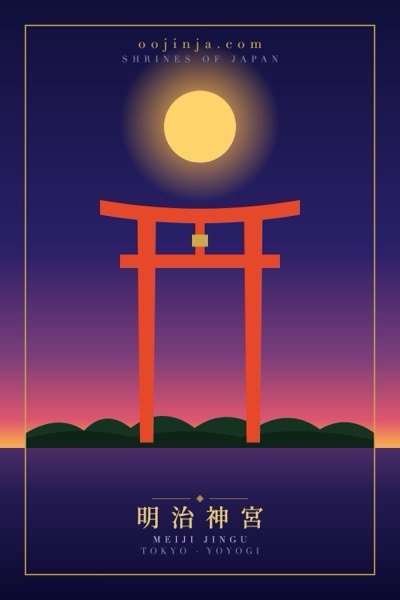
The shrine is built in the nagare-zukuri style, characterized by gabled roofs with extended eaves. The wood is unpainted cypress, giving the structures a warm, unadorned presence. The approach begins at the massive Torii Gate, built from 1,500-year-old cypress trees from Taiwan and standing twelve meters tall. The path passes the sake and wine barrel displays, then enters the forest proper, where gravel walkways lead through camphor and oak. The Main Hall (Honden) is set behind multiple courtyards and gates, accessed through the Haiden (worship hall), where visitors make offerings. The shrine grounds include the Meiji Memorial Picture Gallery, a museum displaying eighty murals of events from Emperor Meiji’s life, and the Treasure Museum, which holds personal effects including the Emperor’s carriage and the Empress’s kimono. The Inner Garden (Gyoen) contains the iris pond, a teahouse, and wells that predate the shrine, remnants of an Edo-period estate.
Festivals & Rituals
- Hatsumōde (New Year Visits, January 1–3) — Meiji Jingū receives more hatsumōde visitors than any other shrine in Japan, with over three million people in the first three days of the year waiting in lines that stretch for hours to make first prayers.
- Spring Grand Festival (May 2–3) — Celebrates Emperor Meiji’s birthday (November 3, moved to May to coincide with Constitution Memorial Day), featuring bugaku court dance and offerings of sake and seasonal foods.
- Autumn Grand Festival (November 1–3) — Honors Empress Shōken and the Meiji era legacy with horseback archery (yabusame), Noh performances, and traditional martial arts demonstrations.
- Iris Viewing (June) — The inner garden opens for iris season, attracting visitors seeking quiet reflection among the flowers Emperor Meiji planted.
Best Time to Visit
Early morning on weekdays. The shrine opens at sunrise, and the forest paths are empty until around 8 AM, when tour groups begin arriving. June is the ideal month for those seeking both solitude and beauty: the inner iris garden blooms, the air is cool before the rainy season intensifies, and crowds thin between Golden Week and summer vacation. Avoid weekends year-round and especially New Year, unless you want the experience of pilgrimage as endurance. Late autumn, when the ginkgo trees along the outer approach turn gold, offers the most dramatic forest visuals.
Visiting Information
e-Omamori
Digital blessing from Meiji Shrine
Carry the protection of this sacred place. Your e-Omamori holds the intention you set — active for 365 days.