Overview
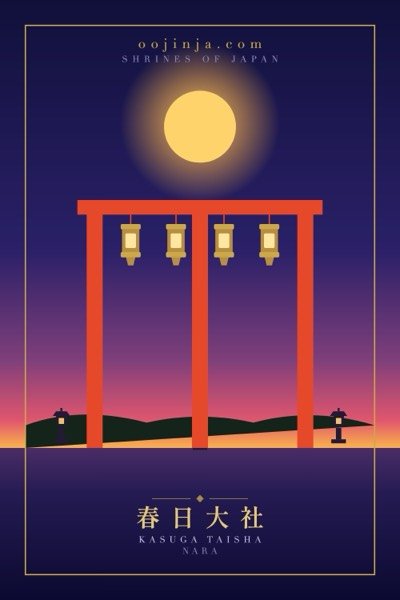
Kasuga-taisha (春日大社) is a Shinto shrine in Nara, Japan. It enshrines Kasuga no Kami, the kami of arts.
- Which kami is enshrined at Kasuga-taisha?
- Kasuga-taisha enshrines Kasuga no Kami, the kami of arts.
- What do people pray for at Kasuga-taisha?
- Visitors to Kasuga-taisha pray for arts.
Sources: Wikidata Q714559
Kasuga-taisha sits at the foot of Mount Mikasa in Nara, surrounded by ancient forest and more than three thousand lanterns — two thousand stone and one thousand bronze — that line its approaches and hang from its eaves. It is the tutelary shrine of the Fujiwara clan, the family that dominated Japanese court politics for four centuries. Twice each year, in February and August, every lantern is lit simultaneously during the Mantōrō festivals, transforming the vermilion corridors into a procession of fire that has continued without interruption since the Heian period. The lanterns were donated by worshippers across eight centuries; the oldest surviving example dates to 1136.
History & Origin
Kasuga-taisha was established in 768 CE by the Fujiwara clan to enshrine the protective kami of their family and the newly established capital at Heijō-kyō (Nara). According to shrine tradition, the deity Takemikazuchi no Mikoto travelled to Nara from Kashima riding on a white deer — an origin story that made deer sacred messengers throughout the surrounding parkland. The shrine’s construction coincided with the Fujiwara consolidation of power through strategic marriages to the imperial family. For over a millennium, Kasuga-taisha operated under a strict twenty-year reconstruction cycle called shikinen zōtai, in which the entire shrine was dismantled and rebuilt to preserve ancient building techniques and ritual purity. This cycle was suspended in the Meiji period but resumed in modified form; the most recent reconstruction was completed in 2016.
Enshrined Kami
Takemikazuchi no Mikoto is the primary deity, a thunder god and divine warrior who appears in the Kojiki as the pacifier of the earthly realm. He is enshrined alongside Futsunushi no Mikoto (another martial deity), Amenokoyane no Mikoto (ancestral kami of the Fujiwara and deity of words and ritual), and Himegami (consort of Amenokoyane). This quartet represents both divine protection and the legitimacy of Fujiwara lineage. The shrine’s association with poetry and courtly arts derives from Amenokoyane’s dominion over sacred speech, making Kasuga a pilgrimage site for poets and scholars throughout the classical period.
Legends & Mythology
The Deer That Carried Thunder
When Takemikazuchi no Mikoto was summoned from Kashima Shrine to protect the new capital, he rode across Japan on the back of a white deer, descending onto Mount Mikasa in a single night. The deer became his permanent messenger, and from that time forward all deer in Nara were considered divine servants, protected by law. Killing a deer in Nara during the Edo period was punishable by death. To this day, over twelve hundred semi-wild deer roam Nara Park as living embodiments of the shrine’s founding. Visitors can purchase shika-senbei (deer crackers) to feed them, though the deer have learned to bow in request — a gesture inadvertently trained over generations of tourist interaction that now appears ritualistic.
Architecture & Features
The shrine complex exemplifies Kasuga-zukuri architecture, a style characterized by brilliant vermilion columns, white walls, and cypress-bark roofs with distinctive upturned gables. The Honden (main sanctuary) comprises four separate shrines housed under a single roof, each dedicated to one of the four kami. The Nandaimon (Great South Gate) and corridors are lined with hundreds of bronze lanterns donated by worshippers, many bearing the inscriptions and family crests of their Edo-period donors. The Fujinami-no-ya (Wisteria Waves Hall) preserves wisteria vines said to be over seven hundred years old. The shrine treasury holds the Kasuga Gongen Genki-e, an illustrated scroll from 1309 depicting miracles associated with the shrine — designated a National Treasure. The surrounding forest, Kasugayama Primeval Forest, has been protected as sacred ground for over twelve centuries and contains enormous cryptomeria and chinquapin trees that predate the shrine itself.
Festivals & Rituals
- Mantōrō (Lantern Festival) — Held February 3 (Setsubun) and August 14-15 (Obon), all 3,000 lanterns are lit simultaneously at dusk, creating corridors of flickering light through the vermilion halls.
- Kasuga Matsuri (March 13) — The shrine’s primary annual festival, established in 849 CE, featuring imperial messengers, court music, and processions in Heian-period costume.
- On-Matsuri (December 15-18) — A festival originating in 1136, with samurai horseback archery (yabusame) and Noh performances dedicated to the kami.
- Wisteria Festival (late April to early May) — Celebration of the shrine’s famous wisteria, which blooms in cascades of purple during Golden Week.
Best Time to Visit
Late April to early May, when the ancient wisteria vines bloom in the shrine gardens and the surrounding forest shows spring green. The deer are particularly active in this season, and crowds are manageable outside Golden Week itself. For the lantern festivals, arrive ninety minutes before sunset to secure a viewing position; the February Setsubun Mantōrō is less crowded than the August event. Early morning visits in any season offer near-solitude among the stone lanterns and moss-covered pathways, with mist often rising from the forest floor.
Visiting Information
e-Omamori
Digital blessing from Kasuga-taisha
Carry the protection of this sacred place. Your e-Omamori holds the intention you set — active for 365 days.