Overview
Kumano Sanzan (熊野三山) is a Shinto shrine in Wakayama, Japan. It enshrines Kumano Gongen / 熊野権現, the kami of purification, rebirth, pilgrimage, healing, the boundary between life and death.
- Which kami is enshrined at Kumano Sanzan?
- Kumano Sanzan enshrines Kumano Gongen / 熊野権現, the kami of purification, rebirth, pilgrimage, healing, the boundary between life and death.
- What do people pray for at Kumano Sanzan?
- Visitors to Kumano Sanzan pray for purification, rebirth, pilgrimage, healing, the boundary between life and death.
- When is the main festival at Kumano Sanzan?
- The main festival at Kumano Sanzan is Nachi no Hi Matsuri (那智の火祭), best experienced in autumn.
Sources: Wikidata Q10403700
Deep in the layered green mountains of the Kii Peninsula, where cedar forests descend toward the Pacific and rivers run the color of jade, three great shrines stand as the beating heart of Japan’s oldest living pilgrimage tradition. Kumano Hongu Taisha, Kumano Hayatama Taisha, and Kumano Nachi Taisha together form the Kumano Sanzan — the Three Mountains of Kumano — drawing together a faith so ancient it predates the categories we now use to name it.
For more than a thousand years, emperors and commoners alike have walked the mountain trails to reach these shrines. At the height of the pilgrimage’s popularity the streams of worshippers were so dense that observers compared them to columns of ants — giving rise to the phrase ari no Kumano mairi, the ant pilgrimage to Kumano. In 2004, UNESCO inscribed the entire complex, along with its sacred routes, as part of the World Heritage site “Sacred Sites and Pilgrimage Routes in the Kii Mountain Range.”
To visit Kumano Sanzan today is to step into that same current — the same mist off the mountains, the same stone-paved paths under the same ancient cedars, the same sense that arrival here marks both an ending and a beginning.
History & Origin
The precise founding date of the three shrines is not recorded and remains uncertain, though the Kumano region appears by name in the Nihon Shoki, Japan’s second-oldest chronicle, where it is described as the burial place of the goddess Izanami-no-Mikoto. This connection to the realm of death and transformation established Kumano’s character long before formal shrine structures existed.
By the Heian period, Kumano had developed into one of the most significant religious landscapes in the country. Emperor Go-Uda’s abdicated predecessor, the Retired Emperor Shirakawa, made his first pilgrimage in 1090 and inaugurated what became a court tradition. The Retired Emperor Go-Shirakawa, one of the most fervent devotees, made the arduous journey no fewer than 34 times. The trail connecting the capital to the shrines — the Kumano Kodo — grew into a sophisticated network of rest stations and subsidiary shrines known as the ninety-nine oji, or child-deity way-shrines.
As aristocratic patronage faded through the Kamakura and Muromachi periods, ordinary pilgrims took their place in ever greater numbers. It was in Kumano, too, that the wandering priest Ippen received a divine oracle that led him to found the Ji sect of Pure Land Buddhism — one of the clearest illustrations of how thoroughly Buddhist and Shinto practice had intertwined here. The Meiji government’s 1868 separation of kami and buddhas dismantled the formal institutional synthesis, but the spiritual atmosphere that produced it has never entirely dispersed.
Enshrined Kami
The presiding deity of all three shrines, and the unifying force of the entire complex, is Kumano Gongen (熊野権現) — the Gongen manifestation of the Kumano divine. In the medieval system of shinbutsu-shugo, the fusion of Buddhism and indigenous kami worship, each of the three great Kumano deities was understood as a local form through which a Buddha revealed itself to sentient beings.
At Kumano Hongu Taisha, the principal kami is Ketsu-miko-no-Kami (家都御子神), also written Ketsu-mi-miko-no-Kami, who was identified with Amida Nyorai, the Buddha of Infinite Light and the guide of souls to the Pure Land. At Kumano Hayatama Taisha in Shingu, Kumano-Hayatama-o-no-Kami (熊野速玉男神) was equated with Yakushi Nyorai, the Buddha of Healing. At Kumano Nachi Taisha, Kumano-Musu-mi-no-Kami (熊野牟須美神) — a goddess associated with creation and the nourishing power of the earth — was linked to Senju Kannon, the Thousand-Armed Bodhisattva of Compassion, whose worship drew countless pilgrims to the great Nachi waterfall that stands beside her shrine. Together these three form the Kumano Sansho Gongen (三所権現), and alongside nine further subsidiary deities they make up the celebrated Kumano Junisho Gongen, the Twelve Kumano Manifestations.
Legends & Mythology
The oldest legend attached to Kumano appears in the Nihon Shoki: when the creator goddess Izanami-no-Mikoto perished after giving birth to the fire deity, she was said to have been buried at Arima-mura in Kumano — a village identified with modern Hanakuri Shrine in Mie Prefecture, just across the prefectural boundary. This made the Kumano mountains a threshold between the living world and the realm of the dead, a quality that saturates the entire pilgrimage tradition.
The Nachi waterfall itself, plunging 133 meters in a single white curtain, was venerated as a manifestation of the divine long before any shrine building rose beside it. Pilgrims who reached the falls believed they were standing at the edge of the Pure Land — the paradise to which the faithful hope to travel after death. The practice of fudaraku tokai, in which Buddhist monks set out from Nachi beach in small sealed boats to cross the sea toward the mythical realm of Fudaraku (Potalaka), the dwelling of the Bodhisattva Kannon, arose directly from this belief.
At Kumano Hayatama Taisha, a boulder called the Gotobiki-iwa on the cliff of Kamikura Shrine is said to be the first site where the Kumano deities descended to earth — the true founding rock of the entire cult. And in the 13th century, the wandering nembutsu priest Ippen received from the Kumano Gongen a revelation that dissolved his doubts about the efficacy of reciting Amida’s name, propelling him to spread the teaching across Japan and establish the Ji sect.
Architecture & Features
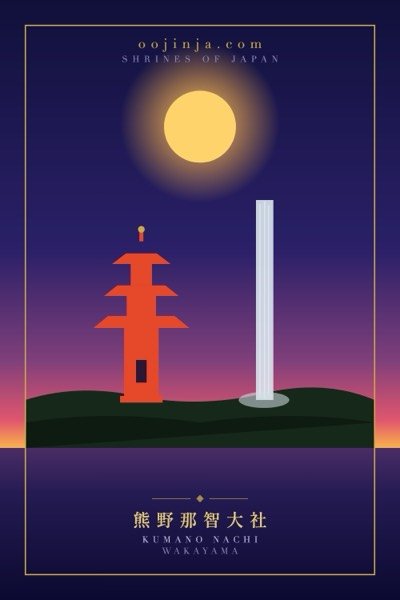
The three shrines of Kumano Sanzan each occupy distinct landscapes and carry their own architectural character, though all share the elegant restraint of classical Shinto shrine design. Kumano Hongu Taisha, rebuilt on its present hillside site after floods destroyed the original oyu no hara river-island location in 1889, preserves that grand original site — now known as Oyunohara — as a sacred open field marked by Japan’s largest torii gate. Kumano Hayatama Taisha in the coastal city of Shingu retains a treasure house holding some of the finest examples of Heian-period votive offerings in western Japan. Kumano Nachi Taisha perches on a forested hillside beside the vermilion three-storied pagoda of Seiganto-ji temple — a surviving emblem of the Buddhist-Shinto synthesis — with the Nachi waterfall visible through the trees behind it.
Connecting all three shrines is the Kumano Kodo pilgrimage road network, sections of which retain their original stone paving. The route is not a museum exhibit but a living trail still walked by thousands each year, and it forms part of a rare trans-continental World Heritage link: the Kumano Kodo and the Camino de Santiago in Spain share honorary partner status, and pilgrims who complete both routes receive a dual certificate. The complex also encompasses Kamikura Shrine and its sacred boulder, the island of Mikefune-jima in the Kumano River, and the subsidiary Buddhist temple Fudarakusan-ji on the Nachi coast.
Festivals & Rituals
The most visually dramatic festival in the Kumano calendar is the Nachi no Hi Matsuri, held on 14 July each year at Kumano Nachi Taisha. Priests carry twelve great portable shrines — each representing one of the Twelve Kumano Manifestations — down the stone steps toward the waterfall while other priests carrying enormous flaming torches purify the path. The procession re-enacts the descent of the divine to the waterfall, and the roar of the flames against the sound of the falls creates an atmosphere unlike any other festival in Japan.
At Kumano Hongu Taisha, the Reitaisai Grand Festival in April draws worshippers for ceremonies of thanksgiving and prayer for the nation. The shrine also hosts a rice-planting ritual known as the Otaue-sai in late spring, connecting the mountain deity to agricultural blessing. Kumano Hayatama Taisha holds its own Reitaisai in October, a time when the sea breeze off the Kumano coast mingles with cedar smoke from the bonfires lit on the approach. The broader pilgrimage itself — walking any of the Kumano Kodo routes and receiving the distinctive gohoshi stamped at each of the three shrines — functions as a living ritual that tens of thousands undertake each year.
Best Time to Visit
Autumn, from mid-October through mid-November, offers the most balanced conditions for the Kumano Sanzan pilgrimage. The summer heat and humidity that make the mountain trails genuinely demanding have passed, the risk of typhoon rain has largely subsided, and the forests along the Kumano Kodo turn amber and deep red beneath clear skies. Accommodation along the pilgrimage routes is easier to secure than during the cherry-blossom peak in April.
Spring (late March through April) is the second-best window: the cherry trees that line the approach to Hongu bloom dramatically, and the cool air suits the longer trail walks. Summer brings green intensity to the cedar forests and the waterfall at Nachi reaches its most powerful flow, but the heat between July and August is serious and advance booking at the guesthouses along the Nakahechi route is essential. Winter visits are quiet and atmospheric, with occasional snow on the mountain passes, though some rest-station facilities reduce their hours. The Nachi no Hi Matsuri on 14 July marks the summer solstice mood regardless of the weather: if the festival is your primary goal, that date is fixed.
e-Omamori
Digital blessing from Kumano Sanzan
Carry the protection of this sacred place. Your e-Omamori holds the intention you set — active for 365 days.